
A patient recently asked me a direct question: “My labs say prediabetes. Can I just get on one of the GLP-1 medications?” I understand the instinct. These drugs have changed how we think about weight and metabolic disease. But the honest answer is more nuanced than a prescription, and it is worth walking through what the evidence actually supports.
What is prediabetes, and why treat it now?
Prediabetes means your blood sugar is higher than normal, but not yet in the diabetes range. It is not a diagnosis to file away. Left alone, a meaningful share of people with prediabetes go on to develop type 2 diabetes within several years. The good news is that this stage is the most responsive to treatment, before complications start.
What actually reverses prediabetes?
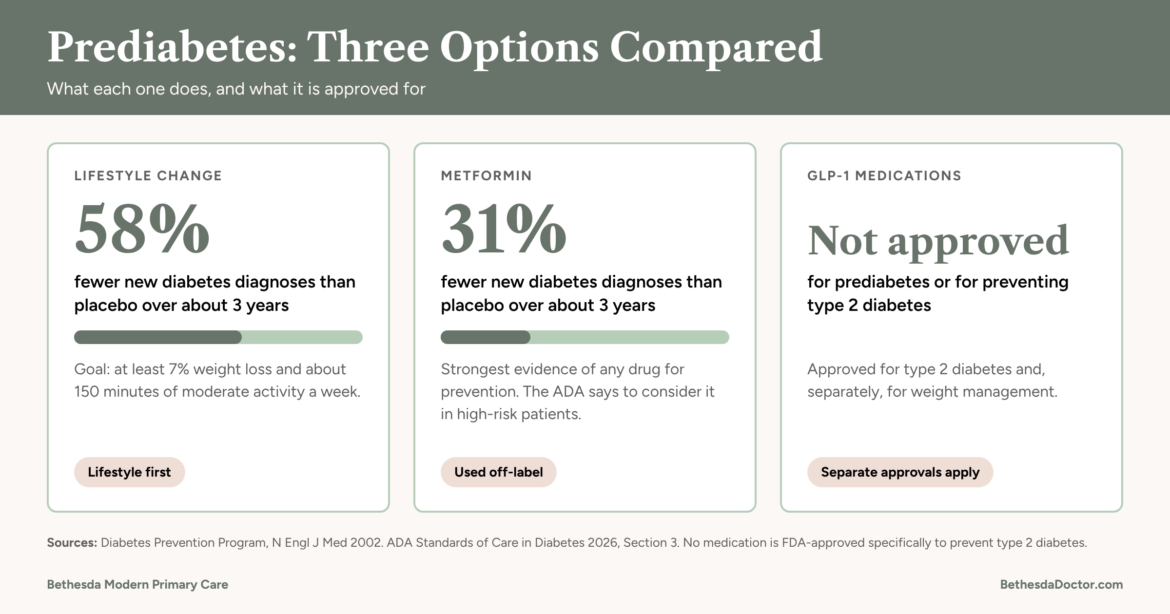
Lifestyle change is still the most effective option we have, and it is not close. In the Diabetes Prevention Program trial, an intensive lifestyle intervention reduced new diabetes diagnoses by 58% over about 3 years compared with placebo (Knowler et al., N Engl J Med 2002). Community programs based on it typically achieve smaller reductions, and the benefit narrows over long-term follow-up. The goal is at least 7% weight loss and about 150 minutes of moderate activity per week (American Diabetes Association, Diabetes Care 2026). There is no single best diet: Mediterranean-style, lower-carbohydrate, plant-based and DASH eating patterns have all shown benefit, so we build a plan around what you will actually keep doing.
When does metformin make sense?
Metformin works best alongside lifestyle change, not instead of it. We use it off-label for prevention in high-risk people, because no medication is FDA-approved specifically to prevent type 2 diabetes.
Guideline position (ADA Standards of Care 2026)
- Lifestyle first: aim for at least 7% weight loss and about 150 minutes a week of moderate activity. In the Diabetes Prevention Program, lifestyle change cut diabetes incidence by 58%, versus 31% with metformin (Knowler et al., N Engl J Med 2002).
- Metformin has the strongest efficacy and safety evidence of any drug for prevention. The ADA recommends considering it in high-risk patients, especially those (ADA, Diabetes Care 2026):
- aged under 60 (most effective at 25 to 44)
- with a BMI of 35 or higher
- with a fasting glucose of 110 mg/dL or higher, or an A1C of 6.0% or higher
- with prior gestational diabetes
If you are in one of those groups, it is worth asking whether metformin belongs in your plan.
Is a GLP-1 medication indicated for prediabetes?
Not specifically, and I want to be straightforward about that. As of the 2026 Standards of Care, the American Diabetes Association states there are no medications FDA-approved specifically to prevent type 2 diabetes (ADA, Diabetes Care 2026). GLP-1 and dual GIP/GLP-1 medications such as semaglutide and tirzepatide are approved for treating type 2 diabetes itself, and separately for chronic weight management in people with obesity or overweight with a related health condition. The guideline notes that these medications have lowered diabetes incidence in certain research populations, but there is not yet the kind of long-term, prevention-specific data that exists for metformin.
In a related trial of tirzepatide for weight management, adults with obesity or overweight, a group that commonly includes people with prediabetes, lost a meaningful amount of weight over time, in the range of 12 to 23% depending on dose (Jastreboff et al., N Engl J Med 2022). That is relevant to metabolic risk, but it reflects the weight-management indication, not a prediabetes label. If you have prediabetes and also qualify for weight-management therapy on its own criteria, that is a conversation worth having. “Because I have prediabetes” is not, on its own, the reason a GLP-1 gets prescribed today.
What should you ask at your next visit?
- Where exactly do my numbers fall, and how were they measured?
- Am I in one of the groups where metformin is usually considered?
- What would a realistic lifestyle plan look like for me, specifically?
- Do I have other risk factors, like obesity, that change my options?
- How often should we recheck?
None of this requires guesswork on your part. It requires an unhurried visit where someone walks through your actual numbers with you. You can read more about how membership works or check frequently asked questions about the practice.
Frequently asked questions
Can prediabetes be reversed?
For many people, yes. Sustained weight loss and regular activity can bring blood sugar back into the normal range, and the evidence for this is stronger than for any medication.
Is metformin recommended for everyone with prediabetes?
No. The American Diabetes Association recommends considering it in high-risk adults, especially those under 60, with a BMI of 35 or higher, with a fasting glucose of 110 mg/dL or higher or an A1C of 6.0% or higher, or with prior gestational diabetes. It is used off-label for prevention and works best paired with lifestyle change.
Can I take a GLP-1 medication for prediabetes?
Not under a prediabetes-specific indication. GLP-1 and GIP/GLP-1 medications are approved for type 2 diabetes treatment or for weight management in people with obesity or overweight and a related condition. Ask your physician whether you meet those separate criteria.
How often should prediabetes be rechecked?
Regular monitoring, often annually, helps track whether lifestyle changes or medication are working and catches progression early, though the exact interval depends on your individual risk.
A plan built around your numbers, not a prescription pad
If you’re in the Bethesda area and looking for a more thoughtful approach to primary care, you can schedule a free discovery call.
Schedule a discovery callReferences
- American Diabetes Association. 3. Prevention or Delay of Diabetes and Associated Comorbidities: Standards of Care in Diabetes-2026. Diabetes Care. 2025;49(Suppl 1):S50-S60. Link
- Jastreboff AM, Aronne LJ, Ahmad NN, et al. Tirzepatide Once Weekly for the Treatment of Obesity. N Engl J Med. 2022;387(3):205-216. Link
- Knowler WC, Barrett-Connor E, Fowler SE, et al. Reduction in the Incidence of Type 2 Diabetes with Lifestyle Intervention or Metformin. N Engl J Med. 2002;346(6):393-403. Link
This article is for general education and is not medical advice for your situation. Please talk with your own physician about your care.