
You lose a colleague’s name in the middle of a meeting. You reread the same email three times. You walk into a room and forget why. If you are in your 40s or early 50s, perimenopause is a likely explanation, and it is usually not the start of dementia.
In September 2026, I co-presented a webinar with Dr. Drew Myers, a reproductive psychiatrist at Bethesda Women’s Mental Health. This post pulls together what we covered and what the research shows.
Watch: a highlight from our webinar with Dr. Drew Myers
Enter your email to get the full conversation with Dr. Drew Myers.
Get the full webinar recording
Hormones. Sleep. Mood.
What is perimenopause brain fog?
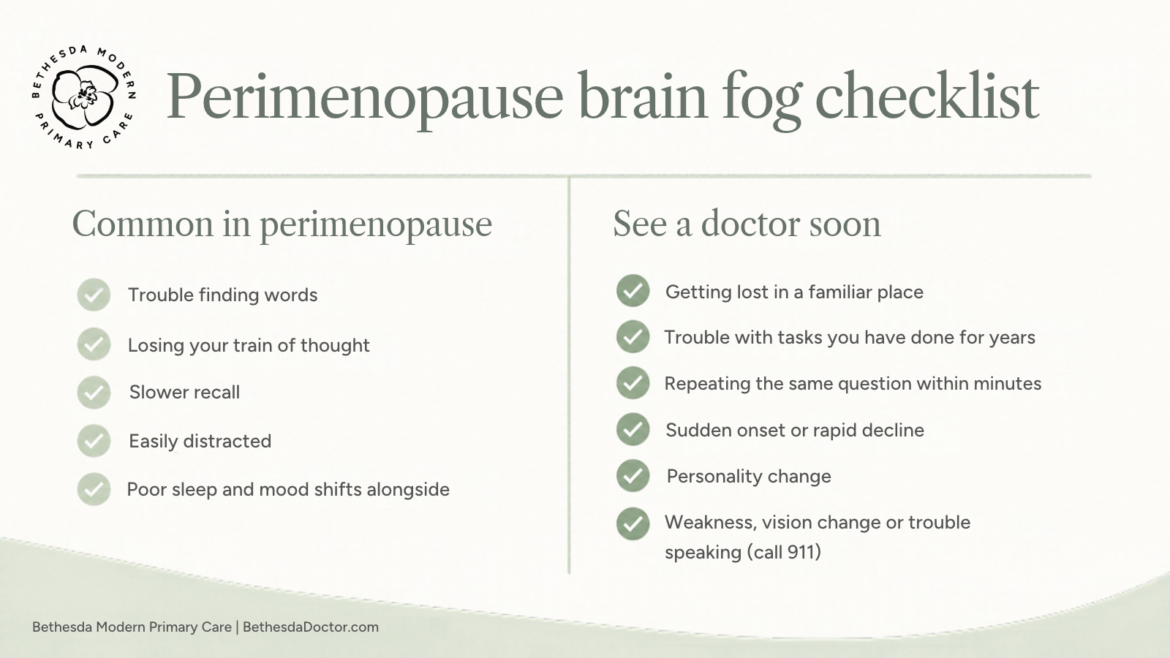
It is trouble finding words, losing your train of thought, slower recall and getting distracted more easily during the transition before your final period. Perimenopause typically starts in the 40s and lasts several years. Estrogen and progesterone rise and fall unpredictably, and your thinking can swing with them. It often arrives with poor sleep, hot flashes or mood shifts. You notice it, and you compensate for it.
Why does perimenopause affect memory and focus?
Three things stack up: hormone swings, broken sleep and mood changes. The research on the first two is clear.
The Study of Women’s Health Across the Nation followed 2,362 women aged 42 to 52 for four years. Women in perimenopause showed reduced learning, including slower processing speed and weaker verbal memory (Greendale, Neurology 2009).
Brain imaging agrees. Brain structure, connectivity and energy metabolism shift across the transition (Mosconi, Scientific Reports 2021). Sleep disturbance also rises across the transition (Kravitz, Sleep 2008), and poor sleep alone dulls memory and concentration.
Is perimenopause brain fog permanent?
For most women, no. In the same four-year study, performance rebounded after menopause. Imaging points the same way: brain measures largely stabilize after the transition, and cognition holds up (Mosconi, Scientific Reports 2021). The rebound finding is observational, so it describes what tends to happen, not what is guaranteed for you.
Brain fog in perimenopause is biology, not weakness and not imagination. It has causes, and most of them are treatable.
What did Dr. Drew Myers and I want women to know?
Three points belong in every conversation about perimenopause brain fog.
- Hormones belong in the conversation. If your mood or anxiety has changed, the hormonal picture matters. Missing it means missing a whole category of treatment.
- Antidepressants can compound the problem. Their side effects, including weight changes and sexual health effects, overlap with perimenopause.
- Past sensitivity is a clue. If your mood shifted with your cycle, during pregnancy or after a baby, you may feel the transition more. The research on how strongly this predicts risk is mixed, so I treat it as a clue, not a verdict.
The evidence for hormones and mood is real but narrow. In a randomized trial of 172 women aged 45 to 60, 17.3% of women on transdermal estradiol with intermittent progesterone developed clinically significant depressive symptoms, compared with 32.3% on placebo. The benefit appeared in early perimenopause, not later (Gordon, JAMA Psychiatry 2018). It was a prevention trial, so it does not make hormones a stand-alone treatment for depression.
Dr. Drew uses an image I like. Picture someone treading water. Therapy, sleep, nutrition and movement strengthen their legs. Medication, whether hormones or an antidepressant, works like a life jacket. Most women do best with both.
What can I do about perimenopause brain fog?
- Fix sleep first. Waking at 2 or 3 a.m. is a classic pattern. Cognitive behavioral therapy for insomnia is the first-line treatment for chronic insomnia (ACP guideline, Annals of Internal Medicine 2016). If you snore or wake unrefreshed, ask about a home sleep study to rule out sleep apnea. For many of my patients, progesterone improves sleep first, and clearer thinking follows.
- Rule out the fixable causes. Before I attribute brain fog to perimenopause, I check thyroid (TSH), B12, a comprehensive metabolic panel and a complete blood count. A low B12 or an underactive thyroid can look identical.
- Move and eat with a target. My starting points are about 100 grams of protein and 30 grams of fiber a day, 150 to 300 minutes of Zone 2 cardio a week and 90 to 120 minutes of resistance training a week. Your numbers depend on your labs and history.
- Consider hormone therapy, slowly. If the workup is unrevealing and symptoms fit, I start low and go slow, with a recheck every two to three weeks. Hormone therapy is not a treatment to prevent dementia (The Menopause Society position statement, 2022), and I do not prescribe it for that purpose.
- Bring in psychiatry when it fits. If mood, anxiety or focus does not improve in four to six weeks, I add therapy or a psychiatrist. Working alongside your primary care team gives the best results.
When should I see a doctor about brain fog?
Book a visit if brain fog affects your work or relationships, or if it comes with low mood, anxiety or poor sleep. Go sooner if you notice any of these:
- Getting lost in a familiar place
- Trouble with tasks you have done for years, such as paying bills or following a recipe
- Repeating the same question within minutes
- Sudden onset, rapid decline or new confusion
- Personality change, or family and friends raising concerns
- Weakness, vision change, severe headache or trouble speaking (call 911)
Expect a longer conversation than a 10-minute visit. I walk through your whole day: sleep, caffeine, food, stress and function. I look for depression, anxiety and sleep problems, and sometimes attention differences that went unnoticed for years.
What should I ask at my next appointment?
- Labs: Have my thyroid, B12 and metabolic panel been checked?
- Sleep: Could sleep apnea or insomnia be part of this? Is CBT for insomnia an option?
- Hormones: Is hormone therapy right for me, and how will we recheck it?
- Mood: Should we screen for depression or anxiety, and do my current medications add to the problem?
Related: menopause and perimenopause care at BMPC and how membership works.
Frequently asked questions
Is perimenopause brain fog real?
Yes. In a four-year study of 2,362 women, those in perimenopause showed reduced learning, including slower processing speed and weaker verbal memory. The dip looked temporary.
Does perimenopause brain fog go away?
For most women it improves after menopause. Studies show performance rebounding and brain measures stabilizing afterward. You do not have to wait it out, because sleep and mood are treatable now.
Can hormone therapy help with brain fog?
In the right patient, hormone therapy can improve the sleep and mood symptoms that make focus worse. It is not used to prevent dementia, and the plan should start low, go slow and be rechecked often.
When is brain fog a sign of something serious?
Sudden onset, rapid decline, getting lost in familiar places, trouble with everyday tasks, personality change or any weakness or trouble speaking need prompt medical evaluation.
A thoughtful workup for brain fog
If you’re in the Bethesda area and looking for a more thoughtful approach to primary care, you can schedule a free discovery call.
Schedule a discovery callReferences
- Greendale GA, et al. Effects of the menopause transition and hormone use on cognitive performance in midlife women. Neurology. 2009;72:1850-1857. Link
- Gordon JL, et al. Efficacy of transdermal estradiol and micronized progesterone in the prevention of depressive symptoms in the menopause transition: a randomized clinical trial. JAMA Psychiatry. 2018;75(2):149-157. Link
- Mosconi L, et al. Menopause impacts human brain structure, connectivity, energy metabolism, and amyloid-beta deposition. Sci Rep. 2021;11:10867. Link
- Kravitz HM, et al. Sleep disturbance during the menopausal transition in a multi-ethnic community sample of women. Sleep. 2008;31(7):979-990. Link
- Qaseem A, et al. Management of chronic insomnia disorder in adults: a clinical practice guideline from the American College of Physicians. Ann Intern Med. 2016;165(2):125-133. Link
- The 2022 hormone therapy position statement of The North American Menopause Society (now The Menopause Society). Menopause. 2022;29(7):767-794. Link
This article is for general education and is not medical advice for your situation. Please talk with your own physician about your care.