
In September I spent a full day at a perimenopause symposium in Baltimore, in rooms full of cardiologists, orthopedic surgeons and women’s health specialists. I came home with pages of notes. I want to share the one idea that tied them all together.
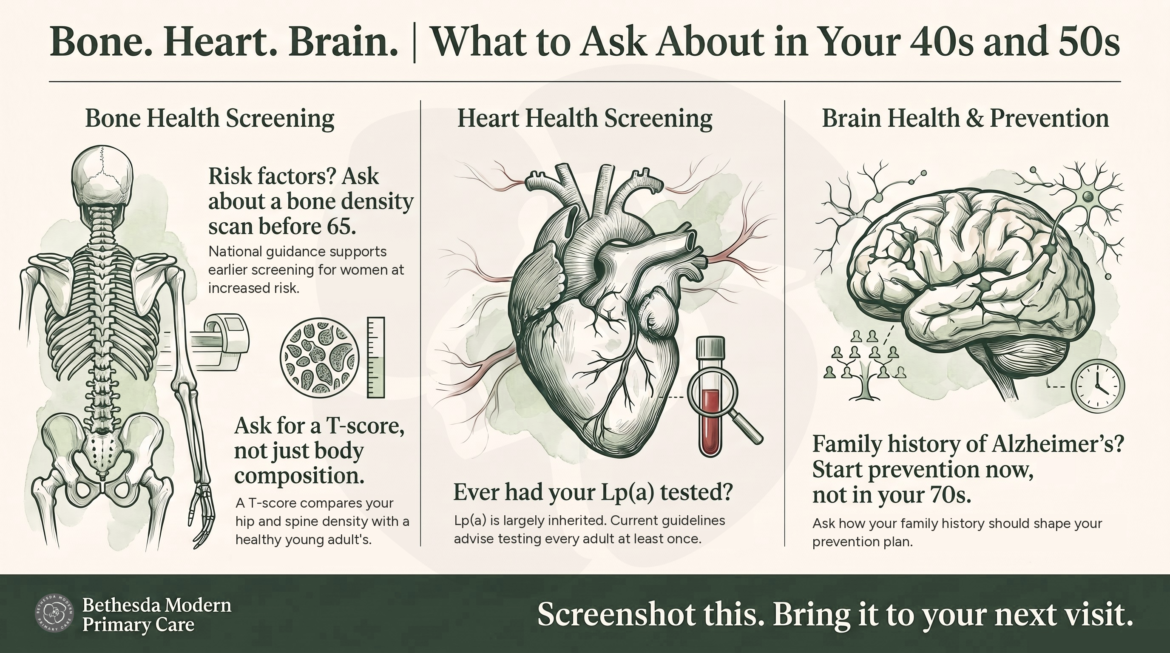
Bone. Heart. Brain.
Menopause is not a single event. It is a transition that reaches our bone, heart and brain, and most of what it changes makes no noise at all. In a short visit, the most bothersome symptom gets the time, and the quiet changes wait.
Why is menopause about more than hot flashes?
Hot flashes, poor sleep and mood changes are real, and they deserve attention. But they are the loud part of the transition. The quiet part happens in places you cannot feel: bone density, cardiovascular risk and long-term brain health. Those are the changes that show up years later, often in a hospital.
A good midlife visit makes room for both: the symptoms that are bothering you now, and the screening that protects you later.
When should a woman get a bone density scan?
National guidance recommends a bone density scan for all women at 65, and earlier for postmenopausal women who are at increased risk of fracture (USPSTF, JAMA 2025). That is why I don’t wait for 65 when a woman has risk factors.
Before I opened my practice, I spent eight years as a hospitalist at Sibley, including as medical director of the orthopedic floor. A hip fracture was never just a broken bone. It was blood clots, weeks in bed, confusion and depression, and most of those fractures were years in the making.
One practical tip: when you book the scan, ask whether it gives a T-score, not just body composition. The T-score compares your hip and spine density with a healthy young adult’s, and it is the number your doctor uses to make decisions.
What is Lp(a), and should I get it tested?
Lp(a), or lipoprotein(a), is a cholesterol particle that is largely inherited and stays stable across a lifetime. A standard cholesterol panel does not include it. The 2026 national cholesterol guideline now recommends that every adult have Lp(a) measured at least once (ACC/AHA, JACC 2026).
Most adults have never been tested. Because the number barely changes, one test is usually enough, and finding it early tells us who is at greater risk to refer to a cardiologist before they need one.
Watch: resistance training and heart attack risk in women
Why does brain health belong in a menopause visit?
Brain health belongs in the same conversation. If your mother had Alzheimer’s, that is a reason to be connected to preventive care now, not in your 70s. Family history should shape your prevention plan from the start.
None of this is about fear. It is about catching the quiet changes while there is still time to do something about them.
What should I ask at my next appointment?
- Bone: Do my risk factors mean I should have a bone density scan before 65? Will it give me a T-score?
- Heart: Have I ever had my Lp(a) tested?
- Brain: My family has a history of Alzheimer’s. What should my prevention plan include?
Why is this hard to get in a typical visit?
None of these steps requires a specialist. They require time, continuity and someone looking ahead. In a short visit, the symptom that brought you in takes the whole appointment. This whole picture is what my practice is built for, because my visits have the time for it. You can read more about how membership works, or why I believe menopause care still falls short.
Frequently asked questions
At what age should women get a bone density scan?
National guidance recommends a bone density scan for all women at 65, and earlier for postmenopausal women at increased risk of fracture. Ask your physician whether your risk factors mean you should be screened sooner.
What is a T-score on a bone density scan?
A T-score compares the density of your hip and spine with that of a healthy young adult. It is the number used to diagnose low bone density, so ask for it when you book your scan rather than a body composition report alone.
What is Lp(a) and how often should it be tested?
Lp(a) is an inherited cholesterol particle linked to heart disease risk. The 2026 national cholesterol guideline recommends that every adult have it measured at least once, and because it stays stable, one test is usually enough.
Should I start preventive care early if my mother had Alzheimer’s?
Yes. A family history of Alzheimer’s is a good reason to connect with preventive care in your 40s and 50s rather than waiting until your 70s, so your prevention plan reflects your history from the start.
Bone, heart and brain, in one conversation
If you’re in the Bethesda area and no one has walked you through bone, heart and brain health, you can schedule a free discovery call.
Schedule a discovery callReferences
This article is for general education and is not medical advice for your situation. Please talk with your own physician about your care.